Published: Detecting and Quantifying Glaucomatous Visual Function Loss with Continuous Visual Stimulus Tracking
Our case-control study in Translational Vision Science & Technology shows that following a moving target with the eyes detects glaucomatous visual function loss, scales with its severity on standard perimetry, and shows no learning effect.
The case-control study behind SONDA’s glaucoma application is out in Translational Vision Science & Technology. Vrijling and colleagues from the University Medical Center Groningen asked a simple question: if the perimetric task is reduced to following a moving dot with the eyes, does the quality of that tracking tell you whether, and how much, a patient has lost visual function to glaucoma?
What Was Done
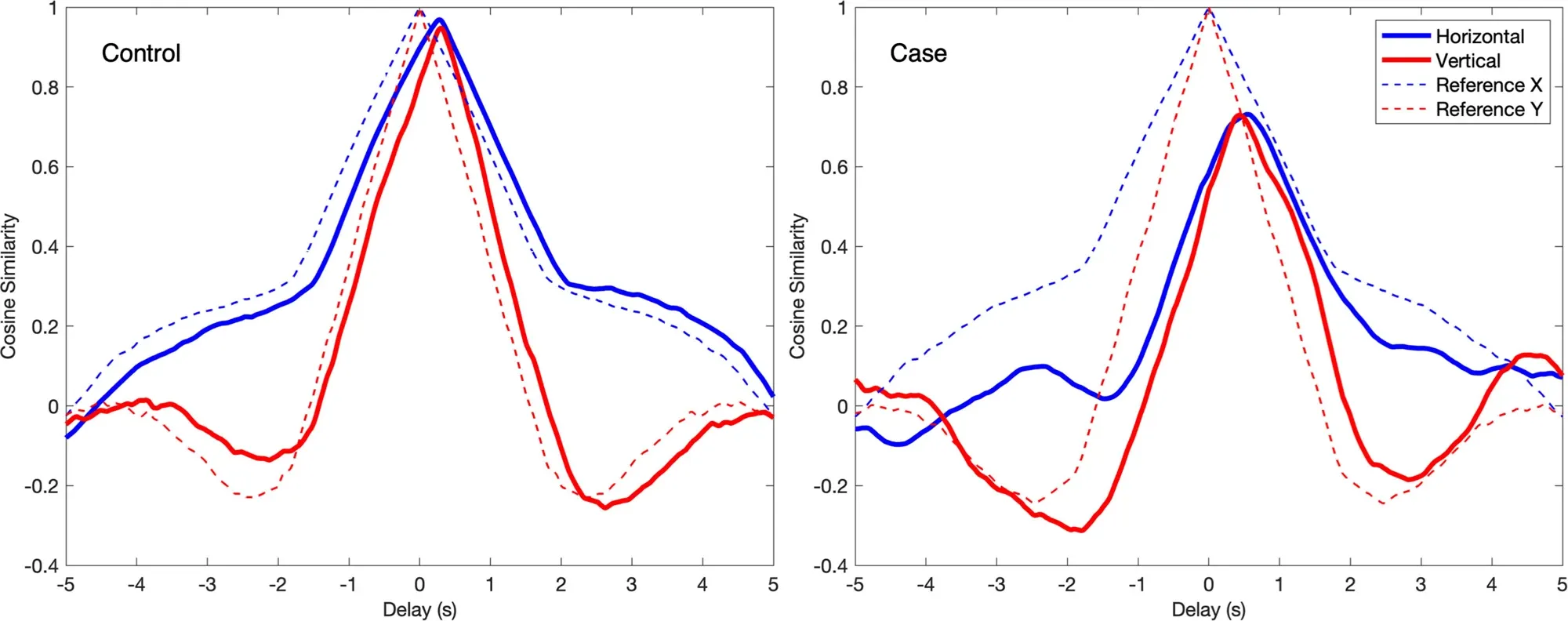
Patients with early, moderate or severe primary open-angle glaucoma and age-matched controls tracked a moving stimulus of Goldmann size III, the same size as a standard perimetry target, while their eye movements were recorded. The stimulus was shown at three contrast levels, 40, 160 and 640 percent. Tracking performance was defined as the agreement between gaze position and stimulus position over time. Every participant also had a standard automated perimetry (SAP) test on the Humphrey Field Analyzer, and the test was repeated to check for a learning effect. The study is registered as clinical investigation NL70382.042.20.
What Was Found
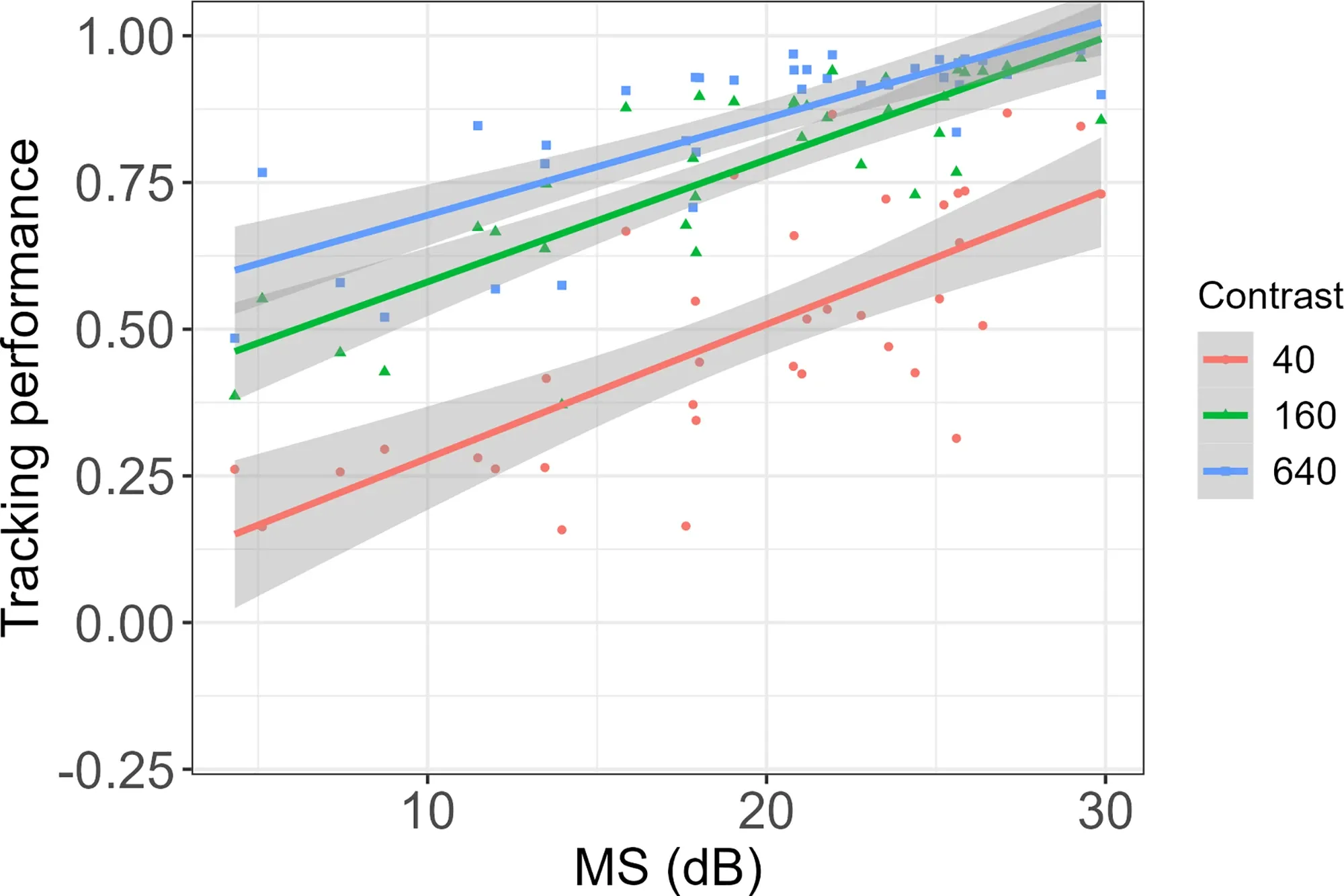
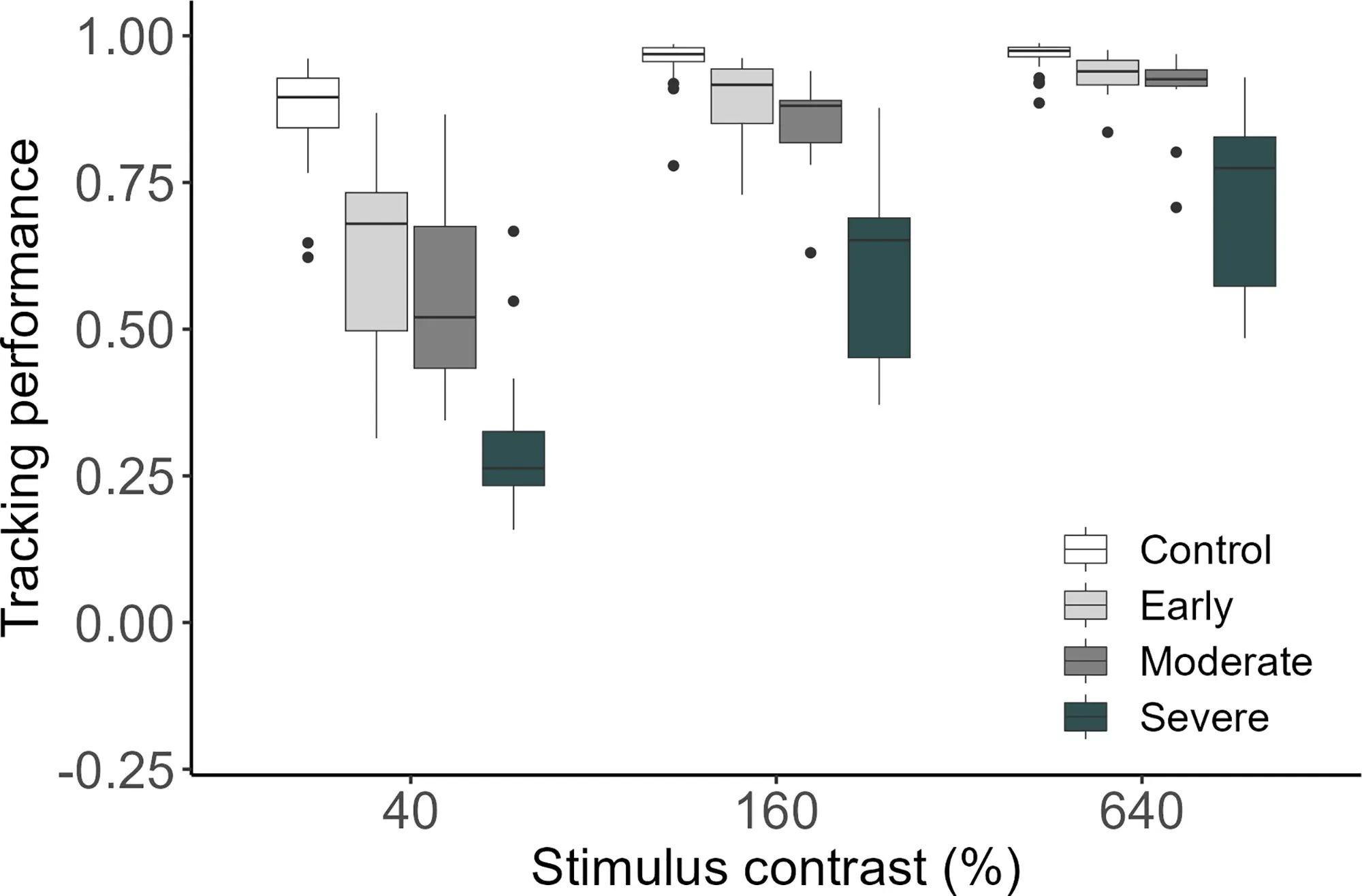
Glaucoma reduced tracking performance, and the reduction grew with the severity of the disease; the cover figure shows the three glaucoma groups against the controls at each contrast. Which contrast worked best depended on the question. For telling early glaucoma apart from healthy eyes, the lowest contrast, 40 percent, was the one at which the difference was significant. For quantifying the loss, the correlation between tracking performance and SAP mean sensitivity was strongest at 160 percent contrast. The first gallery figure shows this relationship across the full range of severity, one regression line per contrast.
There was no significant learning effect between the repeat tests: the first measurement was as good as the second.
Why It Matters
Standard automated perimetry is the reference for visual function in glaucoma, and it is demanding: several minutes of sustained attention per eye, a button to press, and a first test that is often discarded while the patient learns the task. This study shows that a two-minute tracking task, with no button and no instructions beyond “follow the dot”, carries the same information about glaucomatous visual function loss. The authors name the next steps: a large screening study, the reconstruction of a visual field map from the tracking data, and longitudinal data collection. The screening study has since been completed as SONDA’s pivotal clinical investigation and is summarised on the Clinical evidence page.
The paper is open access. All SONDA publications are listed under Publications.
Reference
- Vrijling, A.C.L., de Boer, M.J., Renken, R.J., Marsman, J.B.C., Heutink, J., Cornelissen, F.W., Jansonius, N.M. (2025). Detecting and quantifying glaucomatous visual function loss with continuous visual stimulus tracking: a case-control study. Translational Vision Science & Technology, 14(2), 3. doi:10.1167/tvst.14.2.3