
SONDA Is CE-Marked as a Class IIa Medical Device
The SONDA software is CE-marked under the EU Medical Device Regulation as a Class IIa device, for use by eye-care professionals as an aid in the diagnosis and staging of primary open-angle glaucoma.
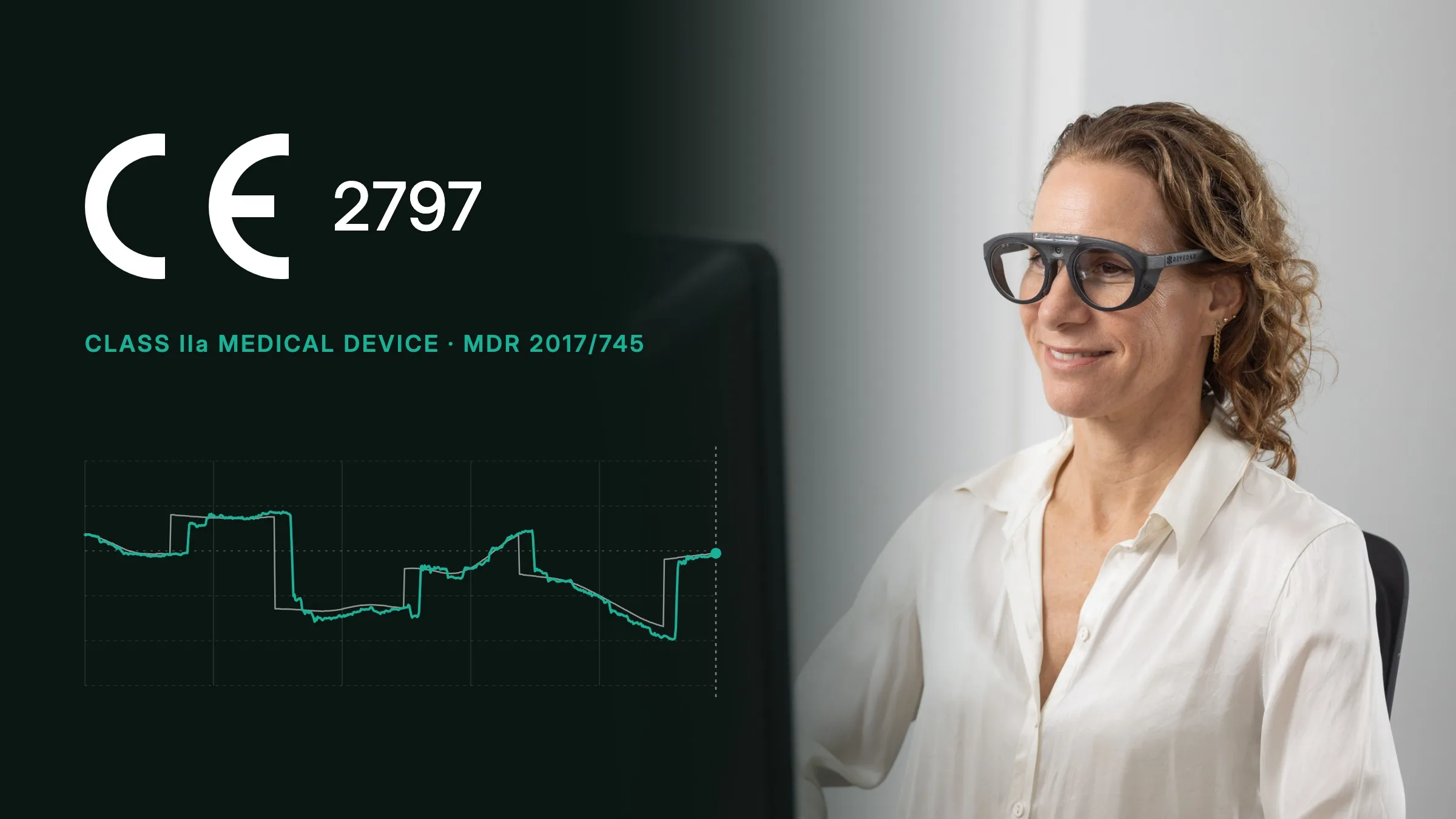
The SONDA software is CE-marked as a Class IIa medical device under the EU Medical Device Regulation 2017/745. Eye-care professionals in the European Union can now use it in clinical routine for its intended purpose: the detection of functional visual field loss, as an aid in the diagnosis and staging of primary open-angle glaucoma in adults.
Class IIa is the class the regulation assigns to software that provides information for diagnostic decisions. Reyedar’s eye-movement-based biomarker went through two independent clinical investigations at the University Medical Center Groningen and a conformity assessment by the notified body BSI, which reviewed the technical documentation, the clinical evaluation and the ISO 13485 quality management system behind the product. The SONDA Hub hardware is a Class I medical device, compliant with EN 60601.
What the Clinical Investigations Showed
- High diagnostic accuracy across all stages of glaucoma. Accuracy of 86% in early, 96% in moderate and 96% in late disease, with a global AUC of 97%.
- Strong correlation with the clinical standard. The SONDA Score correlates with Humphrey Field Analyzer mean sensitivity at r = 0.78.
- Superior patient-friendliness. Patients rated SONDA easier to perform and less tiring than standard automated perimetry (9.0 vs 7.3 and 9.0 vs 6.0).
- Repeatable measurements. A baseline visit and a retest one week later gave the same result (0.72 vs 0.73), with no learning effect.
- Reproducible results across sensors. The supplied Neon eye tracker and an independent EyeLink tracker produced overlapping ROC curves.
The data are on the Clinical evidence page. The case-control study is published in Translational Vision Science & Technology and the pivotal investigation has been submitted for publication; both are listed under Publications.
What the Test Delivers
The patient wears a pair of lightweight glasses with built-in eye-tracking sensors and follows a moving target, with no calibration and no button. From a single test of under two minutes, SONDA delivers objective perimetry, a glaucoma risk indication, and an analysis of blinks and saccadic eye movements, ready as soon as the test ends. How it works is described on the SONDA page.
The Journey Begins Now
After years of research and development, SONDA is available to hospitals, clinics and optometry practices in the EU. Wherever people have their eyes checked, we want to be there to support patients and the professionals who care for them.
Our thanks go to the clinicians and patients of the UMCG who took part in the studies, to our partners, and to the team that carried this through. The announcement as presented on LinkedIn is available as a four-page summary (PDF, 5 MB).